
Our verdictfitvee is worth buying if you want the day decided for you
You’ve seen fitvee on a list or in an ad, and you want to know what a Tuesday looks like once you’ve paid. It looks like this: a session already chosen, a calorie goal already set and an AI coach you can ask to change the day. If deciding what to do is what keeps stopping you, this is the one we’d buy.
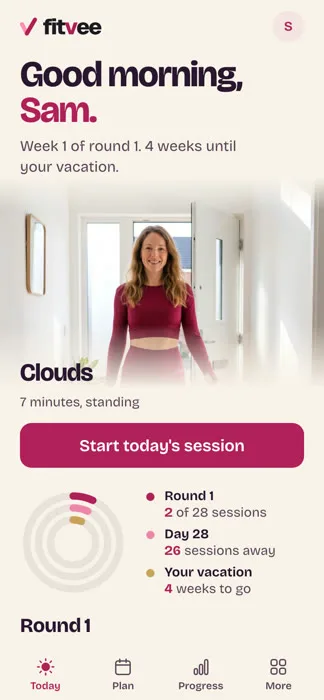
Its best idea is that the plan keeps listening. A check-in after every session sets the next one, every move hides a lighter version under its Easier tab, and your place is held through a bad week. It’s also a pleasure to come back to: you grow a plant, and the finish screen says “Proud of you.” It is a smaller product than the big names, with three plans instead of a vast library and a food diary instead of a nutrition lab.
How it scored
- Personalisation
- 5/5
- Progress and motivation
- 5/5
- Workouts
- 5/5
- Value
- 4/5
- Coaching
- 4/5
- Food tools
- 4/5
Who should not buy this: anyone who wants a free tier, live classes, a human coach, a gym log of sets and weights, or tracking of vitamins and minerals. Skip it too if you need an app-store download, watch or step sync, or sessions that work offline. It’s sold only in the United States, in dollars.
You pay $15.19 for the first 28 days, then $38.95 every 4 weeks. On the walking plan, 12 weeks is $25.99, then $66.65 every 12 weeks (fitvee pricing).
On this page
Our verdictWho fitvee suitsThe first weekWorkoutsFood toolsCoachingPersonalisationProgress and motivationEase of usePrice and renewalWhat members sayAlternativesQuestionsHow we compareSourcesWho fitvee suits
- People who stall at choosing. Today shows one session, not a menu.
- People starting again. Your answers set where you begin (walking plan), and the effort stays conversational.
- People with 7 to 20 spare minutes, at home, with no gym.
- People who want food beside training, in the same membership.
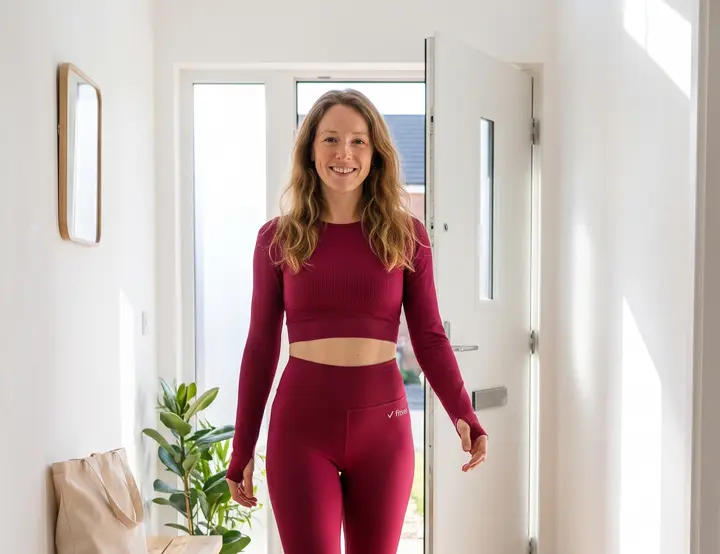
- Any adult. Its pages speak to women after 40 on walking and chair and to men on strength, yet anyone 18 or over can take any of the three quizzes. You’ll see a woman on screen in walking and chair sessions, and a man in strength.
Torn between plans? Pick the one that sounds easier to start, says fitvee, or chair yoga if you’re often unsteady (which plan).
The first week, day by day
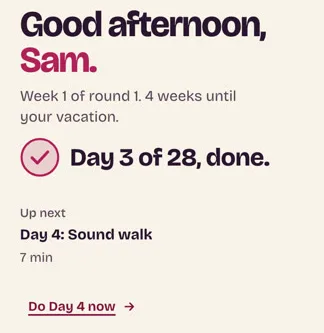
Here’s week one on the walking plan. Your day number counts sessions done, not dates, so a lost Tuesday moves nothing (missed day).
“My Tuesday on the walking plan: a 7-minute session before work, a bowl of oats logged on the way to the train, and a check-in that night. The session was easy to start. What annoyed me was hunting for the oats, since the first result was the wrong brand.”
Before day 1.
A quiz about you and how active you are, then a choice of 1, 4 or 12 weeks with the exact price shown before you pay.
Day 1: Find your feet.
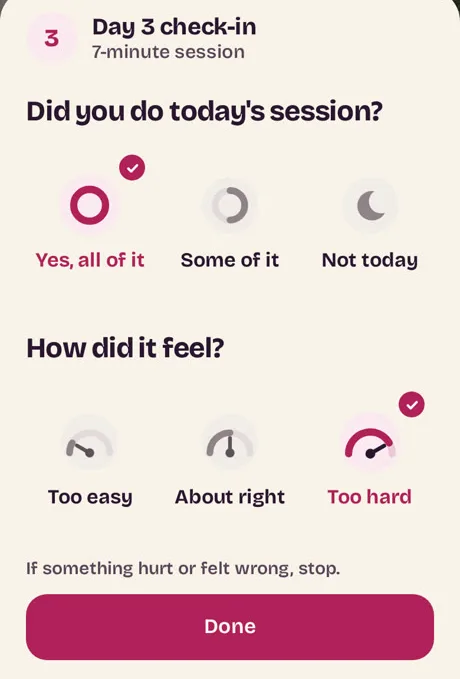
The gentlest start: you breathe, shift your weight from foot to foot and take a few small steps, with a wall in reach. Then comes the screen that drives everything: “Did you do today’s session?” and “How did it feel?” Your first badge lands the same day.
Day 2: Soft knees.
Yesterday’s moves again with a small bend kept in the knee, plus your first slow tai chi-style walk. A prompt then asks “Great work. Walk on for 3 minutes?”
Day 3: Clouds, on a bad day.
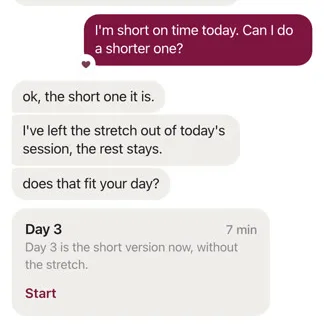
Today your arms and weight drift side to side together, but you’re short on time. You tell Vee, and a card in the chat confirms the shorter version, with the stretch gone from the session’s start sheet. Only the coach can do this. The check-in shapes tomorrow, not today.
Day 4: Sound walk, and lunch.
You listen as you move, and the walk afterwards asks you to notice five sounds. Lunch comes in a package, so you open Calories from More and scan it.
Day 5: Standing like a tree.
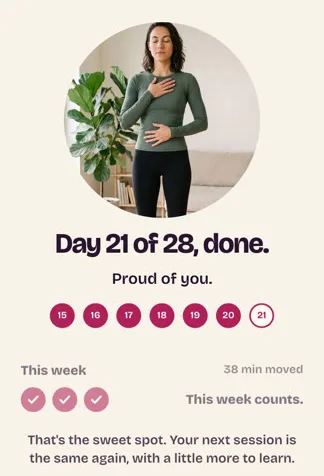
Feet rooted, arms rounded as if hugging the trunk. Three session days in a calendar week is all it takes for the finish screen to say “This week counts.”
Day 6: Slow is smooth.
Everything drops to a slower speed, and your regular lunch turns up ready to add.
Day 7: Rest and stretch.
Ten slow minutes of breathing and gentle stretching, which the plan calls “part of the plan, not a day off from it.”
That’s the product in one week. What you eat never changes your workout. The link is simpler: one quiz drives the plan and the calorie goal, one screen can carry both, and one coach can read both.
Workouts: 5/5
All three plans run 28 days a round: 25 follow-along sessions and 3 rest-and-stretch days. We give it full marks because the sessions are short enough to do, specific enough to hold your interest, and easy to bend.
Tai chi walking.
Seven minutes standing, with a hand free for a wall or counter, starting at 5 moves and reaching 12. Classic tai chi forms arrive one at a time through weeks called Root, Flow, Breathe and Own it. Afterwards you can walk on, for 3 minutes at first and 15 by the end, and take a 3-minute stretch. In people 60 and over, a Cochrane review found tai chi cut the number who fell by 20%.

Chair yoga.
Ten minutes at first, up to 20 by the end. Weeks 1 and 2 are seated, weeks 3 and 4 mix in some standing with a hand on the chair, and nothing happens on the floor. Eagle arms, on day 10, is a slow seated wrap for your shoulders and upper back. Across 33 trials of people 65 and over, yoga, often chair-based, helped walking speed and leg strength compared with doing nothing, though it may not beat other exercise.

Calisthenics.
About 15 minutes: a warm-up, two timed rounds and a cool-down, with an optional extra round of 5 or 6 minutes. Push-ups climb from the wall to the counter, knees and floor, and squats run from a chair to a split squat. The kit is a doorframe, a stair, a sturdy chair and a mat or towel (equipment), and there isn’t a single jump.
The moves.
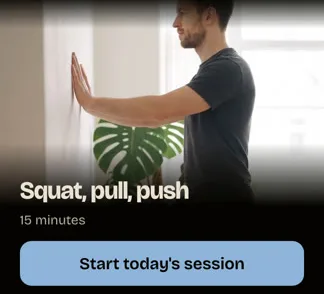
There are 141 move cards, each with steps, cues and Easier, Harder and Take-care parts, and 67 have a written seated version. Anyone can read them free in the exercise library.
The Library.
Any session, any day, on top of your plan, filtered by length, position or body area. It never moves your plan, but it does count toward your week. Walking and chair members get both plans. Calisthenics stands alone.
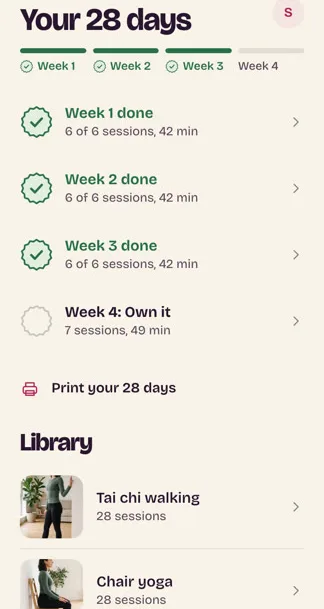
After day 28.
You pick a step on or the same level. Round 2 has new moves and longer sessions: walks up to 25 minutes, chair sessions up to 22, and four moves in each strength block. Past round 2, a step on takes those sessions a level harder.
Volume is the real limit. A week of walking sessions is 42 minutes on the Plan tab, well under the 150 minutes a week adults are told to aim for. The walks and the Library are how you close that gap, and short bouts still count, on observational evidence. There are also no new sessions once round 2 is done.
Food tools: 4/5
Calories opens from More, with the day’s number on top. Your quiz sets it with the Mifflin-St Jeor formula, and you can edit it. There are plenty of ways in:
- Search, starting with foods you’ve logged, then common foods and packaged products. Portions come in the food’s own measures, grams or ounces.
- Barcode scan, macros included, with Not right? and Undo on screen afterwards.
- Plain words, a mic or a photo. “2 eggs and toast” splits into foods you confirm before anything logs.
- Shortcuts. Recent foods, a Usual row for each meal and Quick add, which takes calories alone.
Below the number sit bars for protein, carbs and fat, on a 30/40/30 split you can change. Logging is unlimited, and one day’s meals are there to try.
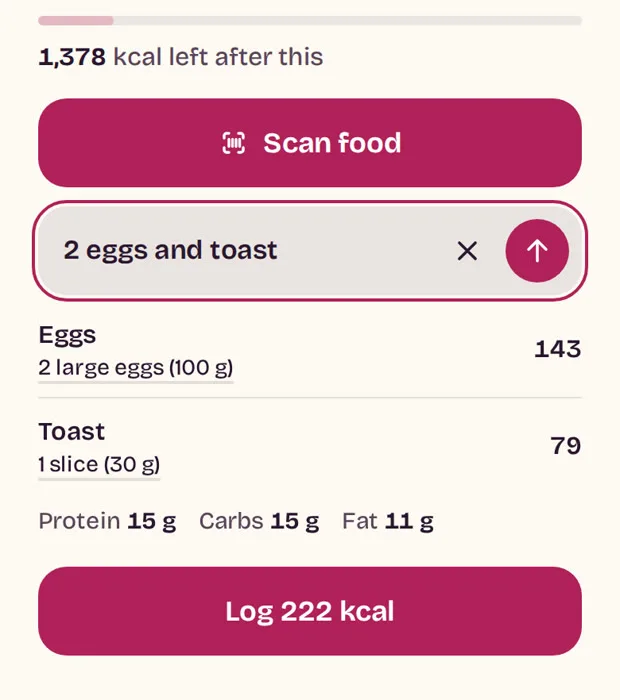
Water goes in by the glass and walking in 10-minute blocks, and reaching a goal brings a burst of confetti and a nudge toward your session. Weight draws a line toward your goal, and waist and other measurements sit with it.
Once you’ve logged a food you can add the food row to Today, so your session and what’s left of your calories share a screen.
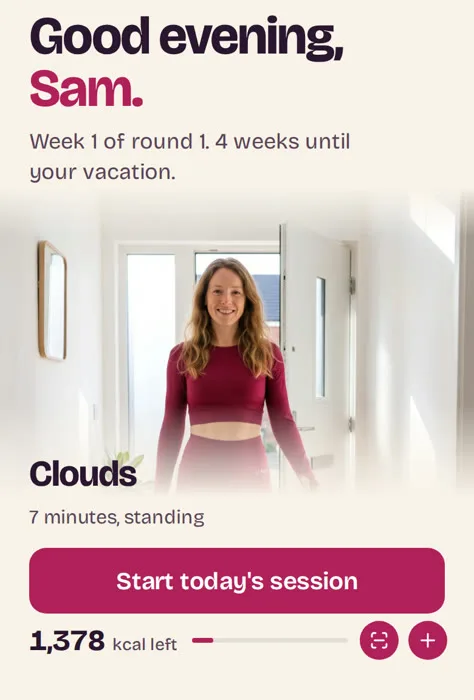
It loses a point on depth. It counts calories, protein, carbs and fat and stops there. No chart shows your food across the weeks, and the diary sits under More until you add that row. Part of the food data comes from Open Food Facts, a volunteer-built database, so a brand or portion can be wrong. Your logged weight never moves your calorie goal.
Coaching: 4/5
Vee looks after walking and chair, and Vin looks after calisthenics. They’re AI and admit it the moment you ask: “Yes, I’m an AI, not a person.” The style is a text from a friend who knows your plan: short bubbles, a little teasing, one next step, and in Vin’s case nothing macho.
The coach can act, which sets it apart from a chatbot that only talks. It can take the session down a level, make every move seated, mark a rest day or, on walking, drop today’s stretch. It can also move your level from the next session, reset your reminder time and save a sore knee, back or shoulder so your moves show matching tips. Ask what to eat and it starts from your log and your goal, but only while your health-data consent stands. Withdraw that and the thread is cleared.
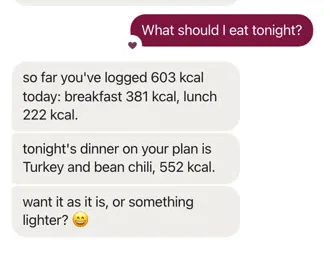
Its orders are sensible. A sore joint gets a gentler or seated option, and sharp or sudden pain gets a plain instruction to stop and see a doctor. It must not treat eating under your goal as a win or suggest skipping a meal, and numbers come only from your own data.
There are firm limits. The coach can’t log food, change your calorie goal, move a day or touch your billing, and there’s no human coach behind it. The evidence is modest too: across 14 articles covering 2,478 people, coaching plus a tracking app beat usual care for weight but wasn’t shown to beat the app alone.
Personalisation: 5/5
The quiz does more than sort you into a plan. Tell the chair quiz you sit down to put your shoes on and the whole plan stays seated, start to finish. On strength, what you say about push-ups and squats places you on each ladder, your main goal replaces four days a round, and the body areas you choose decide your finishers.
Then the plan responds to you. “Too easy” after a full session moves every move a step harder from next time. “Too hard” moves them a step easier, and the app reminds you “Easier still counts.” Choose Not today and you lose nothing.
Reminders learn as well, landing about half an hour before you tend to train, with nothing sent on a day you’ve already done it.
Not every answer counts, though. On walking, only your activity level, past setbacks and sore spots shape the plan; your age and schedule don’t. A level changes the moves, not the minutes, and there’s no setting to change it yourself.
Progress and motivation: 5/5
The plant.
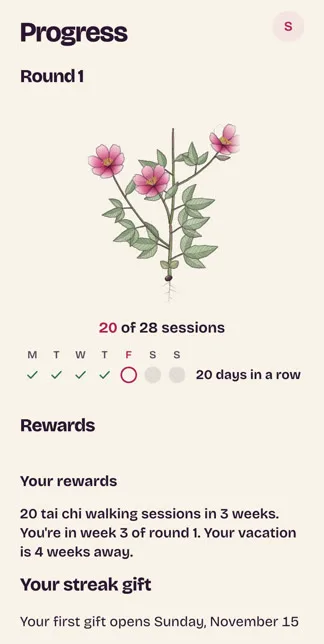
Walking and chair members open Progress to a flower that gains a petal per session and a bloom per week, so even a short day adds something you can see. On strength you get the count and rings without the flower.
The finish.
Each session ends on a screen of its own: your day, your week, the minutes you moved. Four badges mark your firsts and day 28.
The proof.
Day 1 opens with an optional can-do check: chair stands and a balance hold on walking and chair, or push-ups, squats and a plank on strength. On day 28 it returns as “Your numbers, then and now.” That’s the feature we’d show a skeptic.
The forgiveness.
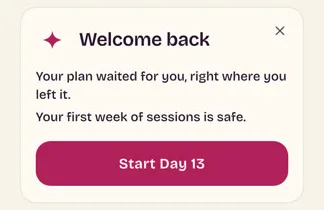
Three session days make a week count, a rest week in reserve covers a bad one, and a broken run can be repaired free within 7 days. After three or more days away, Today greets you with Welcome back and one button, and the banner never says “missed”. Billing continues while you’re away. Patience is the right design: in a study of 96 volunteers, habits took anywhere from 18 to 254 days to settle.
This is a solo app, with no community, friends or leaderboard, and it has no progress photos. Only sessions count here, so a week of perfect food logging earns nothing.
Ease of use
fitvee feels calm. There are four tabs, Today, Plan, Progress and More, and Today is mostly one photo and one big button. A session shows one move at a time with a timer ring.
It runs in your browser on a phone or computer, and adding it to your home screen makes it open full screen, which you’ll need for push reminders. If you like paper, you can print all 28 days on one page.
The small frictions are real. Easier sits in a tab, Calories takes a trip through More at first, and sessions need a connection.
Price and renewal: Value 4/5
Every plan is on one public page, first payment and renewal included. The monthly column spreads each renewal across a year, so $38.95 every 4 weeks comes to $42.20.
| Plan | First payment | Then | A month at renewal |
|---|---|---|---|
| 1 week | $6.93 for 7 days | $38.95 every 4 weeks | $42.20 |
| 4 weeks | $15.19 for 28 days | $38.95 every 4 weeks | $42.20 |
| 12 weeks, walking | $25.99 for 84 days | $66.65 every 12 weeks | $24.07 |
| 12 weeks, chair or strength | $36.99 for 84 days | $94.85 every 12 weeks | $34.25 |
What’s included.
Your daily sessions, the Library, check-ins and the grid, plus the food diary with macros, every tracker, the badges, reminders and an AI coach. That’s a lot of product for one bill, and the 12-week walking plan is the best buy on the page.
What’s extra.
Add-ons such as Premium Workouts and Daily Stretch are separate subscriptions named in the terms.
The catch.
Every plan renews well above its first payment, so budget for the renewal, not the welcome price. The longest plan is 12 weeks, with no yearly rate.
The cheaper routes.
If a food diary is all you want, Cronometer Gold (Cronometer pricing) and MyNetDiary Premium (MyNetDiary help) are each $59.99 a year, and both start free.
The terms.
Checkout adds the date of your first renewal. A 4 or 12-week start brings a reminder email 7 days before the first full-price charge, and a 1-week start puts the date and amount in your sign-up email (renewals). To cancel, open You, then Membership & billing; you keep your plan until the paid time ends (cancel). Refunds happen only where the law requires, and no guarantee is offered (refunds).
What members say
“I used to guess what I ate. Now I log it after each meal and I can see the day at a glance. I have logged most days.”

“I was wrecked after work and asked the coach to go easier today. It did, and I still got the session done instead of skipping it.”
“On a tired day I asked for a seated session. It changed today and I did it from my chair. I did not feel I had given up.”
“My first push-up off the wall. I had been using the easier version for two weeks.”
Alternatives
The full field is on best workout and nutrition apps. If you’re starting from food, read best calorie counter app for beginners.
BetterMe
- Suits
- You want sheer choice and a native app.
- Main strength
- Size, at 4,000+ workouts and 20+ meal plans on its own count (BetterMe help).
- Drawback
- Its price appears at checkout, once the quiz is done (BetterMe help).
Full review: BetterMe review. Head to head: fitvee vs BetterMe.
MacroFactor
- Suits
- You care about nutrition detail above all.
- Main strength
- Logging depth: photo or described meals, barcode and label scans, no ads.
- Drawback
- Training happens in a second app, and the bundle covering both is sold by the year (MacroFactor help).
Centr
- Suits
- You want coached programs with meal plans.
- Main strength
- Any plan opens the whole app, with “no premium tiers or locked content” (Centr help).
- Drawback
- Its lowest monthly figure means paying for a year at once.
Questions
Is fitvee any good?
Yes, if you want a short session chosen for you and food beside it. See “Who should not buy this” at the top.
Is fitvee legit?
It’s a US company’s product with public prices, terms and help pages, and a card statement that reads FITVEE.COM.
Who makes fitvee?
Bolide Labs LLC, Sheridan, Wyoming, US. Contact support@fitvee.com. See fitvee.com/about.
Does fitvee have a free trial?
There’s no free tier and no free trial. The nearest thing is the paid 1-week start, and one full walking session is open to anyone, no sign-up needed.
Does fitvee have a food diary?
Yes, with search, barcode scan, portions, macros and usual foods.
Does fitvee have a coach?
An AI coach, yes. There’s no human coach.
How much does fitvee cost?
From $6.93 for the first 7 days, then $38.95 every 4 weeks, or $24.07 a month at renewal on the 12-week walking plan.
Can I cancel fitvee?
Yes, in your account, at any time and with no reason needed.
Is there an app?
Not in the app stores. It works in your browser and sits on your home screen like an app.
Can men do the walking plan, or women the strength plan?
Yes. Any adult can take any quiz.
Is it safe with a health condition?
Every session carries stop signs, and fitvee lists when to check with your doctor first.
How we compare
We read fitvee’s pricing, help, plan and terms pages on 6 November 2026, the same way we read every other app’s. Our screens come from a test account with sample history, on a preview build, and the people in them are models. Full method: How we compare.
What the scores mean. Each job is scored out of 5. Top marks need the whole job and a real standout; 4 does the main job; 3 comes with a catch, like a key part costing extra; 2 does part of the job; 1 does little or nothing. fitvee gets the same rule as every rival. We don’t add the jobs into one overall number, because they won’t matter equally to you.
Who wrote and checked this page:

Dana Whitfield
Editor
Runs the Eat Move Guide desk and checks every page against the apps’ own pricing and help pages. Has kept a food diary on and off for years and tried most of the big tracker apps.

Nora Lindqvist
App reviewer
Reads each app’s help and pricing pages and goes through its screens. Keeps a list of every price she finds.

Ben Okafor
Plan reviewer
Reads the workout plans and the coach’s changes and checks that the easier options are easy to find. Started training late and still uses the easier versions on bad days.
Sources
- fitveepricing, how it works, about, terms, refunds, Help.
- fitvee plan pageswalking, chair, strength.
- fitvee Helpcancel, renewals, which plan, easier moves, missed day, printable grid, check with a doctor first.
- What we useda test member on a preview of fitvee, 6 November 2026.
- Other appsBetterMe help on features and cost; MacroFactor product page and help on subscriptions; Centr App Store listing and help on subscriptions and the web subscription; Cronometer Gold page; MyNetDiary help on cost.
- Food dataOpen Food Facts, who we are.
- ResearchSherrington et al., Cochrane, 2019; Loewenthal et al., 2023; CDC, adult activity; Jakicic et al., 2019; Chew et al., 2023; Lally et al., 2010.
28 sources, numbered as they appear on this page
fitvee
- 1fitvee product pagefitvee.com, read 6 November 2026
- 2fitvee help: easier movesfitvee.com, read 6 November 2026
- 3fitvee help: missed dayfitvee.com, read 6 November 2026
- 4A test member on a preview of fitveeread 6 November 2026
- 5fitvee help: termsfitvee.com, read 6 November 2026
- 6fitvee pricing pagefitvee.com, read 6 November 2026
- 7fitvee help: which planfitvee.com, read 6 November 2026
- 10fitvee product pagefitvee.com, read 6 November 2026
- 16fitvee help: printable gridfitvee.com, read 6 November 2026
- 17fitvee pricing pagefitvee.com, read 6 November 2026
- 18fitvee pricing pagefitvee.com, read 6 November 2026
- 19fitvee help: termsfitvee.com, read 6 November 2026
- 20fitvee pricing pagefitvee.com, read 6 November 2026
- 21fitvee pricing pagefitvee.com, read 6 November 2026
- 22fitvee pricing pagefitvee.com, read 6 November 2026
- 26fitvee product pagefitvee.com, read 6 November 2026
- 27fitvee help: helpfitvee.com, read 6 November 2026
- 28fitvee help: cancelfitvee.com, read 6 November 2026
Sherrington et al. (Cochrane)
- 8Sherrington et al. (Cochrane) research reviewdoi.org, read 6 November 2026
Annals of Internal Medicine
- 9Annals of Internal Medicine research reviewpubmed.ncbi.nlm.nih.gov, read 6 November 2026
CDC
- 11CDC public guidelinecdc.gov, read 6 November 2026
Jakicic et al.
- 12Jakicic et al. research reviewdoi.org, read 6 November 2026
Open Food Facts
- 13Open Food Facts pageworld.openfoodfacts.org, read 6 November 2026
Journal of Medical Internet Research
- 14Journal of Medical Internet Research research reviewpubmed.ncbi.nlm.nih.gov, read 6 November 2026
Lally et al.
- 15Lally et al. research paperdoi.org, read 6 November 2026
MacroFactor
- 23MacroFactor product pagemacrofactor.com, read 6 November 2026
Centr
- 24Centr App Store listingapps.apple.com, read 6 November 2026
- 25Centr help: managing your web subscription centr comhelp.centr.com, read 6 November 2026